
Dog Breeds
Dog Tips
Training
Exercise
Medical
Interviews
Miscellaneous
About DB
Contact DB
Resources
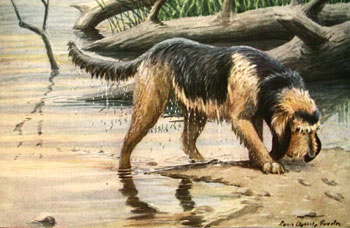
Illustration by Louis Agassiz Fuertes
It is said that every sizable stream in Great Britain has its otter. To hunt this elusive and wily animal, a very distinct type of dog has been evolved. The requirements of the hunt demand the keenest of noses, the staunchest of “wills to hunt,” the utmost courage, and the ability to stand the roughest of wet and dry coursing.
These qualities have been assembled in the otterhound, which may be described as a bloodhound clad in the roughest of deerhound coats. In general, he is all hound, with deep-set eye showing the haw. He is broader in the brow than the bloodhound and not quite so large, but he has the same fine carriage, on straight, strong, and heavily boned legs; large, sound, and partly webbed feet. The hair over the eyes is long and ragged, and there is a strong tendency toward beard and moustache.
He is a great favorite in Great Britain, but is rarely seen in America. In color he may be “hound colors,” or “self-colored,” fawn, brown, tawny, or black. The working dogs are so hardened by rough work that they are not particularly suitable as housedogs; when reared to it, however, their fine qualities render them exceptional companions even for children.
The Otterhound is a large, rough-coated hound with an imposing head. Originally bred for hunting, it has great strength and a strong body with long striding steps. This makes it able to perform prolonged hard work. Otterhounds generally weigh between 80 and 120 pounds (36 to 54 kg). They have extremely sensitive noses which make them inquisitive and perseverant in investigating scents. Consequently, they need particular supervision. They are friendly dogs with a unique bass voice which they use frequently.
The Otterhound hunts its quarry both on land and in water and it has a combination of characteristics unique among hounds; most notably an oily, rough, double coat and substantial webbed feet. The use of otterhounds to hunt otters by scent ceased in the Britain in 1978 when it became illegal to kill otters, at which point otter hunts switched to hunting mink or coypu.
Health
The breed lives to between 10 and 13 years old, although some have reportedly lived to be 15 or older. The Otterhound requires considerable exercise. They can be good family dogs but need to be kept in a secure property since they can jump fences up to 5 feet high.
An endangered breed
There are only an estimated 1,000 or so Otterhounds in the world and somewhere between 350 and 400 in the US. Even in the early 20th century, when otter hunting was most popular as a sport, Otterhounds were not numerous. They are now considered the most endangered dog breed in Britain since only 51 were born there in 2006. They are on the list of Vulnerable Native Breeds as identified by the UK Kennel Club, and as much as possible is being done to save the breed. [2][3] Indeed, experts now view otterhounds as more endangered than the Giant Panda.[2] However, while the domestic dog has many breeds which vary greatly in morphology it is important to remember these are all classified as the same sub-species Canis lupus familiaris. This sub-species is in no way endangered (unlike the Giant Panda Ailuropoda melanoleuca whose entire species has an estimated population of just 1600 in the wild).
Did you enjoy this article? Let us know what you think by commenting below. Don't forget to Friend us on facebook and subscribe to our twitter feed to stay updated! Thanks for reading, recommend us to your friends! |